
















In celebration of the 250th anniversary of the signing of the Declaration of Independence, CCSU professor, Dr. Matthew Warshauer, spoke to the South Windsor community about the American Revolution on March 25th.
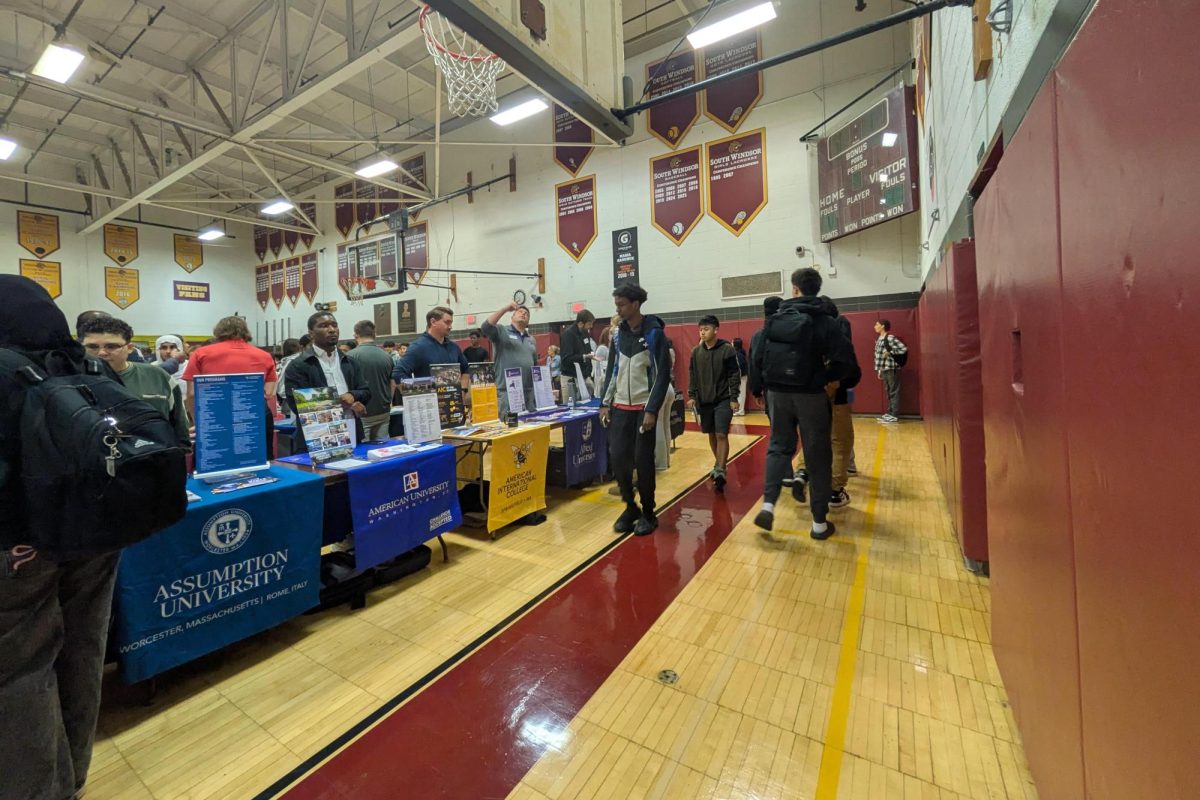
Prior to the speech, Dr. Warshauer spoke directly with students and answered their questions.
Students asked about the role of Loyalists vs. Patriots, how Connecticut fits within the Revolution story, and how Connecticut’s geography played a role during the war.
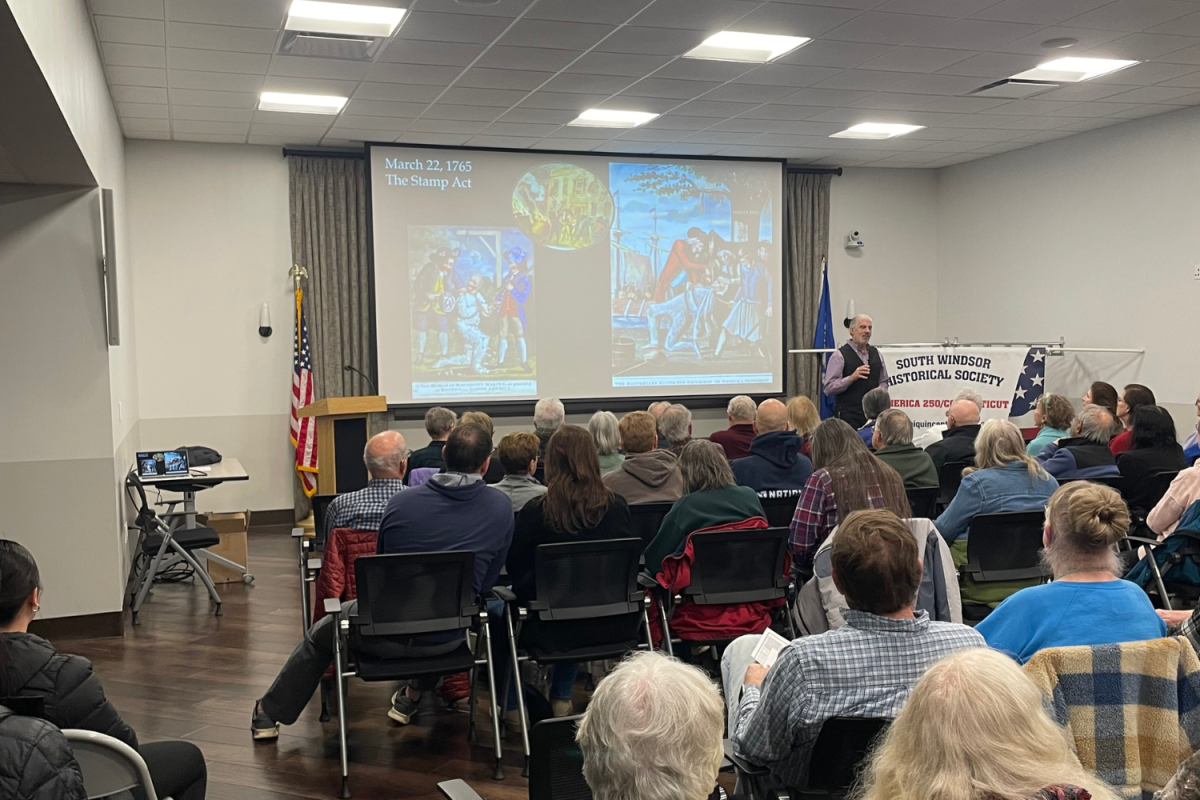
Around 7:00 PM, doors opened to the public, and community members started filing into the South Windsor High School Annex cafeteria to hear the professor talk about the American Revolution. Towards the beginning of the event, Dr. Warshauer jokingly asked the public one question: “When we think about divisions in the Connecticut River today, when we think about Eastern Connecticut vs. Western Connecticut, what do we think about?”
Some audience members responded, “money”.
But the professor was looking for a different answer: Yankees vs. Red Sox.
“There’s another time in Connecticut history in which this river divided us,” Warshauer said. “And, it literally determines which direction the state of Connecticut goes in terms of the American Revolution. Whether we support the patriots, or whether we go more towards the loyalists. And this is the dividing line. And it’s deep, and it goes back several decades before the American Revolution. But it absolutely defines the direction that we go in.”
Warshauer’s talk provided an overview of the history behind the American Revolution, and Connecticut’s involvement in that history.
Dr. Warshauer discussed the Stamp Act, an act passed by Great Britain in March of 1765, which increased taxation in the colonies to generate revenue for Britain, highlighting how the Stamp Act led to the creation of the Sons of Liberty. The Sons of Liberty were a revolutionary group first formed in Boston, who, according to Warshauer, were considered “nothing but trouble”. Sons of Liberty groups weren’t just formed in Massachusetts, Warshauer noted, as some groups formed in Connecticut as well, on the east side of the river.
The Sons of Liberty were responsible for wreaking havoc against British officials in the colonies. Some of their actions included going into the houses of tax collectors and royal officials, and ransacking them, throwing furniture out the windows, piling it in the street and setting it on fire. In Massachusetts, the Sons of Liberty went to the royal governor’s house where they wrapped a thick rope around the house and used it to rip the home off of its foundation. They would also participate in tarring and feathering people.
Warshauer also talked about influential figures of the time period, like Jared Ingersoll, an attorney and statesman, from Pennsylvania.
“By this point in American history, [Ingersoll] was a longtime resident of New Haven,” Warshauer explained. “He’s an attorney. He’s a well-respected member of that community. He was in England in late 1765 to 1766. And he’s there, right before the Stamp Act is imposed, talking to Benjamin Franklin. They bring Benjamin Franklin into the parliament, and they ask him a whole series of questions.”
The professor continued to talk about important historical figures including John Durkee, Israel Putnam, and Hugh Ledley, as well as important events in the history of colonial America, such as the Great Awakening and the French and Indian War.
At the end of the presentation, Warschauer expressed his love of history and why he enjoys telling others about it.
“I love to explore ideas, and that to me is the most important aspect of history,” Warschauer said. “It’s not about memorizing names and dates and things like that. It’s not about being good at Jeopardy or quizzes. The study of history is the study of ideas.”
Warschauer’s talk reinforced the idea that learning is not just about gathering information and remembering it all at once. It’s also about trying to have fun at the same time. When you have fun, you learn. And when you do something great for your community, you’re learning at the same time as well.
“I think that all teaching and all presentations are a form of performance art,” Warschauer explained. “And if you’re simply walking into a classroom or a talk like tonight and all you’re there for is to disseminate information, that’s no fun. In my view, if people are laughing and are having a good time, that means they’re paying attention.”